
Art teacher prep time is the part of the job nobody sees. The lesson lasts an hour. The cutting, sorting, sample-making and clean-up can take far longer.
So how much art teacher prep time do you really need? Less than you think, if the lesson is built the right way. Here’s where the hours go, what one real lesson takes to prep, and how schools keep art without burning out the people who teach it.
How much art teacher prep time is normal?
Teachers already work long weeks. In RAND’s 2024 State of the American Teacher survey, teachers reported working an average of 53 hours a week. Similar working adults reported 44.
The time set aside for planning is much smaller. An NCTQ review of district contracts found an average of 51 minutes of planning time per day. That time has to cover every subject.
Art adds something other subjects don’t: physical materials. Paper has to be cut. Paint has to be poured. A sample has to be made. That’s why art teacher prep time often spills into evenings and weekends.
Where art prep time actually goes
Most art prep falls into four buckets.
Finding and planning the lesson
This is the biggest hidden cost. Searching for an idea, checking that it fits the grade, and writing the steps can take longer than teaching it.
Gathering and cutting supplies
Twenty-five students need twenty-five sets of materials. Every sheet has to be the right size and color.
Making a sample
A finished example shows students where they’re headed. It also shows the teacher where the lesson might go wrong.
Set-up and clean-up
Passing out materials and collecting scraps eat into class time if no one has a plan.
What prep looks like for one scripted lesson
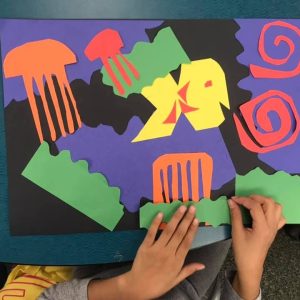
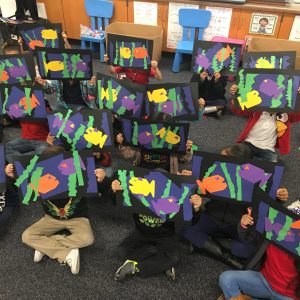
Here’s how one Meet the Masters lesson handles each bucket. Take Matisse’s Shapes from the Henri Matisse unit. Students draw with their scissors to make a cut-paper sea picture, just as Matisse did.
The planning is already done
The lesson is written for four levels: Kindergarten, Beginning, Intermediate and Advanced. Each “Working With” lesson plan has a suggested timeline built to fit a 50 to 60 minute class. The script tells the instructor what to say, what to ask and what to demonstrate.
The supply list is exact
A one-page Project Preparation Guide tells the coordinator what each student needs. For kindergarten and beginning students, that’s one 12″ x 18″ sheet of black construction paper, one 9″ x 12″ sheet of royal blue, one 9″ x 6″ sheet of green and two 4″ x 6″ sheets in bright colors. Cutting guides show how to get those sizes from standard sheets.
The Monet’s Colors lesson in the Claude Monet unit works the same way. The guide even spells out the paint: one pint each of red, yellow and blue tempera per 120 students.
Everyone knows their job
The red book splits prep among a few people, so no one carries all of it:
- The coordinator uses the Project Preparation Guide to order supplies and fill a folder for each classroom.
- The classroom teacher hands out the “Learning From” packets between the artist assembly and the art project.
- The instructor, whether a teacher or a parent volunteer, makes one practice example and follows a one-page set of volunteer instructions.
Set-up and clean-up are timed
The lesson builds in 5 minutes to pass out materials and 5 minutes to clean up. Student helpers do both. Everything else in the hour is art.

How to cut art teacher prep time without cutting quality
Whether you use a curriculum or build your own, these habits save hours:
- Start from a written lesson, not a blank page. Planning is the biggest hidden cost.
- Prep one class set, then repeat. Cut paper for every class that week in one sitting.
- Make one sample and keep it. A good example can serve every class at that level.
- Keep supplies in folders by classroom. Grab-and-go beats sorting on the morning of the lesson.
- Give students jobs. Paper passers and scrap collectors save you minutes every class.
- Ask for help. Parent volunteers can cut, sort and even teach when the steps are written down.
For schools and districts
If you lead curriculum, VAPA or expanded learning, art teacher prep time is a staffing question. A program that asks every teacher to plan from scratch will fade by spring.
The fix is to centralize what can be centralized. One coordinator orders supplies once for the whole school. Lessons arrive written and timed. Teachers, art specialists or volunteers teach from the same plan.
Our elementary art curriculum includes 35 artist units, each written for multiple grade levels. Art supply kits and step-by-step video demos for each level are available as add-ons.
Districts notice the difference.
“The packaging, directions, and techniques of the master artists made implementation straightforward.”
— Carolyn Carter, Chief Academic Officer, Baseline Human Educational Services, Oak Park, Michigan (read the Baseline case study)
“Meet the Masters provided systematic, engaging lessons with clear instructions and minimal supplies…”
— Lisa Mortieau, Art Teacher, East Helena School District, East Helena, Montana
“The structure of the scripted lesson plans made it so easy to present to students.”
— Lizz Davis, Elementary School Teacher & Volunteer, Castle Heights Elementary, Price, Utah
You’ll find more in our testimonials from teachers, parents and principals. Comparing programs? Our guide to choosing a K-8 art curriculum covers what to look for.
FAQ: Art teacher prep time
How much art teacher prep time do you need per lesson?
It depends on the lesson. A lesson you design yourself can take hours of planning and supply prep. With a scripted lesson, art teacher prep time drops to gathering pre-listed supplies, making one sample and reading the script.
Can a classroom teacher with no art background teach art?
Yes. Meet the Masters lessons are scripted, so classroom teachers, art teachers or parent volunteers can lead them with no art background.
How long is an elementary art lesson?
Meet the Masters classroom projects are timed for 50 to 60 minutes. The National Art Education Association’s Opportunity to Learn standards call for at least 50 minutes of art each week.
Bring Meet The Masters to your school
Art shouldn’t cost teachers their evenings. With the planning done and the supplies listed, prep becomes a short checklist, and the hour goes to the art.
