
A kindergartner and a fifth grader can look at The Starry Night and see two different paintings. That gap is the whole puzzle of choosing an art curriculum for mixed ages.
The younger child sees stars that swirl. The older one notices the dark cypress tree, the sleeping village and the way the whole sky seems to move.
Maybe you teach a combination class. Maybe you run an after-school program where first graders sit beside fifth graders
. Or you lead art for an entire K-8 school. Either way, the lesson has to stretch older students and still work for the youngest ones.
Here’s what to look for in an art curriculum for mixed ages, and how one Meet the Masters lesson does it.
What makes an art curriculum for mixed ages work?
Mixed-age groups are everywhere. Small schools combine grades. After-school programs group students by schedule, not birthday. Even a single-grade class holds a wide range of skill.
Educators have long seen the upside. A Manitoba Education guide to multilevel classrooms puts it this way: “Diversity is not a challenge to be overcome, but an asset and a resource that promotes learning.” The guide notes that older students build leadership while younger students learn from older peers.
That only happens when everyone starts from the same place. A strong art curriculum for mixed ages gives you three things:
- One shared artist. The whole group looks at the same work and talks about it together.
- Clear levels. Each student gets a project matched to their age and skill.
- The same supplies at every level. One supply order and one setup serve the whole room.
One artist, four levels: how Meet the Masters handles mixed ages
Every Meet the Masters artist unit is written at four levels: Kindergarten, Beginning (grades 1-2), Intermediate (grades 3-4) and Advanced (grades 5-8). That’s how one elementary art curriculum covers kindergarten through eighth grade.
Each unit follows the same three-step method. Students meet the artist in an “Introducing” presentation (20-45 minutes). They practice a technique in a “Learning From” packet (15-30 minutes). Then they make their own artwork in a “Working With” project (50-60 minutes).
The scripts change by level. The artist stays the same. That’s the heart of a good art curriculum for mixed ages. Here’s how the Vincent van Gogh unit builds one painting across four levels.
Kindergarten: one swirling star
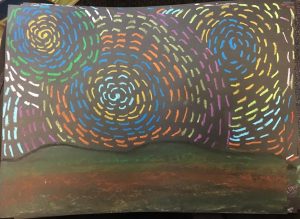
Kindergartners hear a story in their own classroom. Vincent liked to paint at night, so he wore a straw hat with candles on top. The scripted introduction takes about 9 minutes, and a 6-minute practice page warms up small hands.
For the 45-minute project, kindergartners follow the Beginning lesson with one change. They draw only one star.
Beginning (grades 1-2): stars over the hills
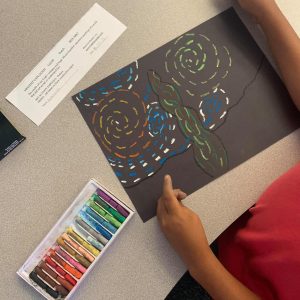
Beginning students practice a “broken line spiral” on newsprint first. Then they draw a horizon line of hills on black paper and fill the sky with oil pastel texture. The lesson plan suggests one star for grades K-1 and one to three stars for grade 2.
Intermediate (grades 3-4): add the cypress tree
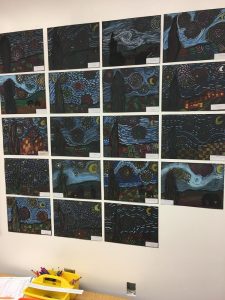
Intermediate students build the same night sky with 3 to 5 stars. They add a cypress tree in the foreground, shaped like a flame. The hills fill with groups of lines that look “like a patchwork of fields from the air.”
Advanced (grades 5-8): add the village
Advanced students do all of that, then add a village of 3 to 5 houses built from simple geometric
shapes. Their introduction goes deeper too, using the song “Vincent” by Don McLean to explore the artist’s life.
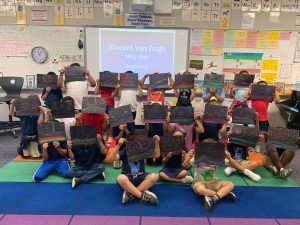
Four levels. One painting. Every student leaves with a Starry Night of their own.
Open the Project Preparation Guide in the Van Gogh unit. Every level needs the same materials: one 9″ x 12″ sheet of black construction paper, one sheet of newsprint, a paper towel, an artist profile slip and a box of oil pastels, peeled and broken in half.
In an art curriculum for mixed ages, that matters. Nobody juggles two supply lists. The coordinator preps once, and every table looks the same.
The timing flexes, too. Each “Working With” plan lists suggested minutes beside every step to fit a 50-60 minute class. The guide adds: “If you have the luxury of more time, please let the students work a little slower.”
Other units follow the same pattern. In the Matisse unit, kindergartners use the Beginning lesson of “Matisse’s Shapes,” a
construction-paper cutout project.
A simple approach for combination classes
This is where a leveled art curriculum for mixed ages pays off. Because the levels share an artist, supplies and core steps, a combination class can start together. Everyone learns the broken line spiral and draws the hills. Older students then add the next level’s elements, such as the cypress tree or the village.
What educators say about teaching across ages
Kristina Franklin teaches art in Fruitvale School District in Bakersfield, California. She described a conversation with one parent:
“I had a parent stop me in the halls and express how much her children loved the curriculum. She was overjoyed that formal art education was included in our school day and that it was a curriculum that challenged the older elementary students, and was able to be done by the younger ones as well. She had a first and fourth grader at the time.”
— Kristina Franklin, Art Teacher, Fruitvale School District, Bakersfield, CA (read the Fruitvale case study)
Through its ArtSmart program, Leonardo’s Children’s Museum in Enid, Oklahoma, provides Meet the Masters curriculum and art supplies to local schools for teachers to implement. One participating teacher wrote:
“Meet the Masters appears to be a comprehensive program adapted to a variety of age ranges and abilities. Instructors are very engaging with students. Adapted well to varied ages of development.”
— Participating teacher, shared by Charlet Ringwald, Executive Director, Leonardo’s Children’s Museum, Enid, OK (more testimonials)
For schools and districts
For curriculum directors, VAPA leads and ELOP leaders, mixed ages are a scheduling fact. A K-8 site, an after-school room with grades 1-5, or a campus with combination classes all need an art curriculum for mixed ages that scales.
- One adoption, K-8. All 35 artist units include Kindergarten, Beginning, Intermediate and Advanced levels.
- No art background required. Scripted lessons let classroom teachers, art teachers and parent volunteers lead.
- Training built in. Training videos show MTM staff demonstrating each project step by step for all grade levels.
- Standards alignment. The curriculum maps to California VAPA visual arts standards. The National Core Arts Standards likewise frame visual arts learning from Pre-K through high school.
Fruitvale School District serves about 3,000 students across five elementary schools and uses Meet the Masters at every one of them. If you’re comparing programs, our guide on how to choose a K-8 art curriculum walks through the questions to ask.
FAQ: art curriculum for mixed ages
What is the best art curriculum for mixed ages?
The best art curriculum for mixed ages teaches one artist to the whole group, then offers leveled projects so each student works at the right challenge. Meet the Masters does this with four levels in every artist unit, from kindergarten through grade 8.
Can one art lesson work for kindergarten through 8th grade?
Yes, if it’s leveled. In Meet the Masters, every grade studies the same artist, but the project grows with the student. A kindergartner draws one swirling star. An advanced student adds a cypress tree and a village.
Do teachers need an art background to teach mixed-age art?
No. Meet the Masters lessons are scripted, with suggested times for every step, so classroom teachers, art teachers and parent volunteers can lead them with confidence.
Bring Meet The Masters to your school
Every classroom holds a range of ages and abilities. Your art curriculum for mixed ages can plan for that from the first lesson.
Get pricing for your school or district, and let every student, from kindergarten up, paint their own starry night.
