
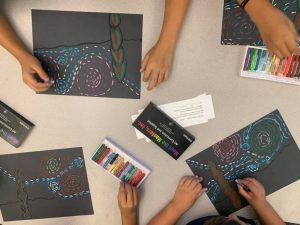
The best elementary art lesson plans do one thing well. They let any adult walk into a classroom and teach real art in under an hour.
That’s harder than it sounds. A cute craft fills a Friday afternoon. A great lesson teaches a technique, introduces an artist, and still ends with something a child is proud to take home.
So what separates the two? Here’s what to look for, with two examples from our own red books.
What makes elementary art lesson plans the best?
Most teachers searching for lessons aren’t art specialists. They’re classroom teachers, enrichment staff or parent volunteers. The right lesson plan respects that.
A real artist and a real art element
Every strong lesson starts with a “why.” Students learn who made the work, what the artist was trying to do, and which art element they’re practicing: texture, shape, color, line.
That’s the difference between art and crafts. Students leave knowing a name and a technique, not just a finished product.
A timeline that fits a class period
Good plans are honest about time. Each of our “Working With” lesson plans has a suggested timeline next to every heading, built to fit a 50-60 minute class. Set-up, demonstration, studio time and clean-up all have minutes attached.
Steps a non-specialist can follow
The best elementary art lesson plans are scripted. They tell the teacher what to say, what to demonstrate, and what students should answer. Students repeat each step right after the demonstration, so nobody gets lost.
A version for each grade level
A kindergartner and a sixth grader can study the same artist. They shouldn’t do the same project. Strong elementary art lesson plans scale the same lesson up or down by level.
Inside one of our elementary art lesson plans: Van Gogh’s Starry Night
Here is how a Meet the Masters lesson on Vincent van Gogh unfolds.
It starts with a story. In the kindergarten script, students hear that van Gogh liked to paint at night, before electricity. So he put small candles on a straw hat. Then the class looks at The Starry Night and decides whether the sky feels peaceful or exploding.
Students learn the vocabulary: texture, spiral, brushstrokes. They pick up pretend paintbrushes and swirl them in the air.
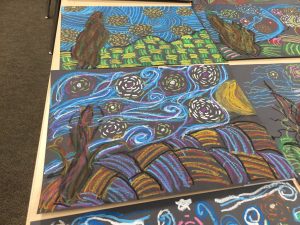
Then comes the project, “Van Gogh’s Textures.” The Beginning Level plan runs like this:
- Set-up and orientation: 10 minutes
- Organizing the work area and learning how oil pastels differ from crayons: 6 minutes
- Practicing a broken-line spiral on newsprint: 7 minutes
- Drawing a horizon line of hills: 5 minutes
- Drawing the spiral star in a textured sky: 15 minutes
- Adding texture to the hills, mounting the artist profile slip and clean-up: 12 minutes
The supply list is short: oil pastels, one sheet of black 9″ x 12″ construction paper, newsprint, a paper towel and glue.
The plan grows with students. Kindergartners draw one star. Intermediate students add a cypress tree in the foreground. Advanced students add a village built from simple geometric shapes.
Those projects tend to last. One former student put it this way:
“While I was in elementary school, Meet the Masters visited many times and I was in awe by the whole experience. To this day I still think about the lessons I learned and still have my rendition of Van Gogh’s Starry Night. I would love to inspire young students the same way Meet the Masters instructors have inspired me and so many of us.”
— Jeanene Serna, Former Meet the Masters Student
A second example: Matisse’s paper cutouts
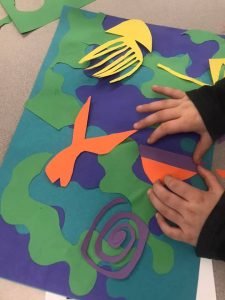
Not all elementary art lesson plans need pastels. In “Matisse’s Shapes,” students explore Henri Matisse and his cut-paper designs.
The Beginning Level plan uses construction paper, scissors and glue sticks. Students cut wavy edges into blue paper to make water. Then they cut seaweed from green paper and turn small colored rectangles into abstract fish.
The art element is shape. The vocabulary includes abstract, overlap and cutout. At the end, the class holds up their work and the room becomes an aquarium.
What teachers say about scripted lessons
Teachers who use our elementary art lesson plans tend to mention the same thing: structure.
“The structure of the scripted lesson plans made it so easy to present to students.”
— Lizz Davis, Elementary School Teacher & Volunteer, Castle Heights Elementary, Price, UT
“Teachers were able to implement the clearly written Meet the Masters lesson plan with ease.”
— Josh Barbera, 2nd Grade Teacher, Village Elementary School, Coronado, CA
Read more on our testimonials page.
Why the right lesson matters
Art lessons are more than a break in the day. In a randomized study of Houston’s Arts Access Initiative, researchers found that more arts learning experiences reduced disciplinary infractions, improved writing scores and increased students’ compassion for others (Brookings).
Good elementary art lesson plans also map to standards. The National Core Arts Standards organize art learning around four processes: Creating, Presenting, Responding and Connecting. A lesson that pairs an artist’s story with hands-on making touches several at once.
For schools and districts
If you’re choosing elementary art lesson plans for a whole school or district, one great lesson isn’t enough. You need a sequence that works across grades and staff.
Each Meet the Masters artist unit comes as a complete red book. It includes the assembly script by level, “Learning From” student packets, a project preparation guide for the supply order, volunteer instructions, artist profile slips, award certificates and the “Working With” lesson plans.
That structure helps districts start fast. Fruitvale School District in Bakersfield runs the program at all five of its elementary schools.
“Our students had never had formalized art education before Prop 28 funding allowed us to hire art
teachers.”
— Cara Nicoletti & Kristina Franklin, Art Teachers, Fruitvale School District, Bakersfield, California
 teachers.”
Read the full Fruitvale School District story. If you’re in California, the CDE’s Visual and Performing Arts resources cover the state’s arts standards and framework.
Comparing programs? Our guide on how to choose a K-8 art curriculum walks through what to ask.
FAQ
What should elementary art lesson plans include?
Elementary art lesson plans should include an artist or art element, a clear objective, a supply list, step-by-step instructions, a timeline that fits one class period, and a way for students to share their work.
How long should an elementary art lesson be?
Most elementary art lessons fit in 45 to 60 minutes. Meet the Masters “Working With” lesson plans are built for a 50-60 minute class, with minutes listed for each step.
Can a teacher with no art background teach these lessons?
Yes. Scripted lessons tell the teacher what to say and show. Meet the Masters lessons are written so classroom teachers, art teachers and parent volunteers can lead them.
Bring Meet The Masters to your school
The best lesson is the one that actually gets taught. Meet the Masters gives your teachers scripted lessons for every level, built around the world’s great artists.
See how our elementary art curriculum fits your school, then get pricing for your school or district.
