
Is art required in elementary school? Most parents assume the answer is yes. On paper, it usually is.
But a rule in a state code is not the same as a paintbrush in your child’s hand. Here’s what “art required in elementary school” means on paper, why art still goes missing, and what you can do about it.
According to the 2024 ArtScan from the Education Commission of the States 42 of 52 jurisdictions (the 50 states, Washington, D.C., and Department of Defense schools) require schools or districts to provide or offer arts instruction at the elementary level. Every state has arts standards.
California is a good example. Education Code section 51210 lists visual and performing arts, including dance, music, theater and visual art, as part of the required course of study for grades 1 through 6.
So when a parent asks, “Is art required in elementary school?”, the honest answer is usually yes. The harder question is whether it’s actually happening.
Why art goes missing even when it’s required
At Meet the Masters, we talk with a lot of parents, PTA members and principals. Even with art required in elementary school by state law, the same two problems come up again and again.
There’s no art teacher
Many elementary schools have no art specialist on staff. The requirement falls to classroom teachers, who already carry reading, math, science and history. Not every teacher feels ready to plan an art lesson from scratch.
Testing crowds the schedule
Even where teachers want to teach art, test prep gets the time first. Art becomes the thing that happens “when there’s room.” Often there isn’t.
The result: art required in elementary school on paper, but a holiday craft or two a year in practice.
Why hands-on art matters more than ever
Children spend much of the school day on screens now. And many of them are hands-on learners.
Art gives those students something different. They make choices. They express an idea in color and shape. They hold the result in their hands.
There’s a memory payoff, too. Writing something down helps you remember it. Making something works the same way. When students hear an artist’s story and then create a project in that artist’s style, the history sticks.
We see this in schools that use the program. In Oceanside Unified, fourth graders still recalled Picasso’s cubism, Van Gogh’s brushwork and Frida Kahlo’s self-portraits months after the lessons.
> “Students are really enjoying learning about each artist and how their life story shaped them to become a master.”
> – Ashley Haight, Enrichment Teacher, Grades 1-5, Oceanside Unified School District
What parents can do if art isn’t happening
You don’t need an art degree to change this. Often, change starts with one parent asking a good question.
Start with your PTA
PTA members are often the strongest advocates for art. Bring the question to a meeting. A group request carries more weight than a single email.
Ask the principal or district office specific questions
Keep it friendly and concrete:
– How often does each class get art instruction right now?
– Who teaches it, and what curriculum do they use?
– Is there funding for art staff or supplies this year?
– Would the school welcome parent volunteers to help teach art?
Offer to help teach
This is where a scripted program helps. Meet the Masters provides everything, so classroom teachers, art teachers or parent volunteers can lead a lesson. No art background is needed.
What one lesson looks like
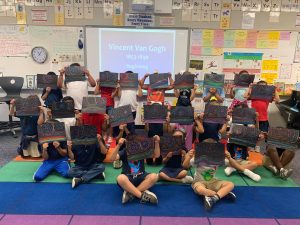
Take the Vincent van Gogh unit. Each artist book has lessons written for four levels: Kindergarten, Beginning, Intermediate and Advanced.
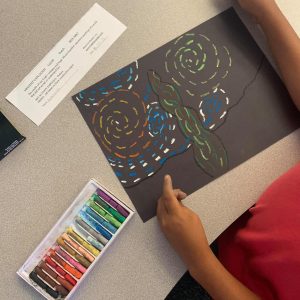
In kindergarten, the instructor tells the story of The Starry Night in about nine minutes. Students do a six-minute warm-up page. Then they spend 45 minutes making their own starry sky.
The supplies are simple: a 9×12 sheet of black construction paper, a sheet of newsprint for practice and oil pastels broken in half. Students learn a “broken-line spiral” and fill the sky with texture, not solid coloring. The volunteer instructions fit on one page.
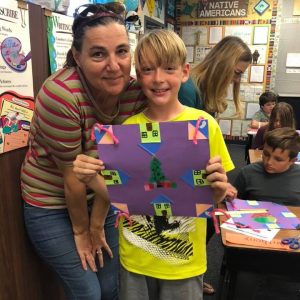
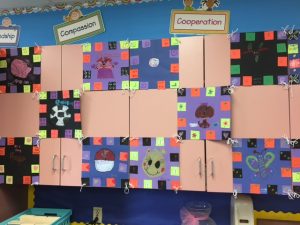
Other units connect art to reading and history. In the Faith Ringgold unit, students study her story quilt Tar Beach. They learn she also wrote and illustrated 17 children’s books. Then they design their own quilt patterns.
For schools and districts
If you lead curriculum, VAPA or expanded learning, the requirement is only half the job. The other half is a program teachers can actually deliver.
In California, Proposition 28 now sends ongoing arts funding to schools, starting in 2023-24. Districts with 500 or more students must spend at least 80 percent of it on arts staff. The rest can go to training, supplies and materials.
Fruitvale School District in Bakersfield used Prop 28 to hire two art teachers. They chose Meet the Masters for about 3,000 students across five elementary schools.
> “Our students had never had formalized art education before Prop 28 funding allowed us to hire art teachers.”
> – Cara Nicoletti and Kristina Franklin, Art Teachers, Fruitvale School District
> “Students look forward to art time each week, and parents have commented on how much their children love the lessons.”
> – Cara Nicoletti and Kristina Franklin, Art Teachers, Fruitvale School District
A schedule that survives testing season
Schools that make it work find a few days close together. They hold the artist assembly first. The classroom projects follow over the next few days, while the story is still fresh. Students complete their “Learning From” packets in between.
Each classroom project is planned for 50 to 60 minutes. That fits inside a normal class period.
Comparing programs? Our guide on how to choose a K-8 art curriculum walks through what to look for, and our elementary art curriculum page shows all 35 artist units.
FAQ: Is art required in elementary school?
Is art required in elementary school in every state?
Not everywhere. Art required in elementary school is the norm, though: the 2024 ArtScan found that 42 of 52 jurisdictions require arts instruction at the elementary level. Rules on how much time and who teaches it vary widely.
Can a parent volunteer teach elementary art?
Yes. With a scripted program like Meet the Masters, parent volunteers can lead full lessons. The script, supplies list and step-by-step instructions are provided.
How much time does an elementary art lesson take?
A Meet the Masters classroom project takes 50 to 60 minutes. Schools usually hold the artist assembly first and teach the projects within a few days.
Bring Meet The Masters to your school
Is art required in elementary school? In most states, yes. Let’s make sure it actually happens. Whether you’re a parent, a teacher or a district leader, we’ll help you find a plan that fits your schedule and budget.
