
Visual arts play an important role in the elementary school children, as through this art form one can develop emotional expression, fine motor skills, and the ability to see the world around them in a conscious manner. However, not everyone knows how to involve children in such lessons in a way that makes them interesting rather than boring. This article explores possible ways to work with elementary children, discuss remote lessons in this subject, and determine which concepts should be introduced first.
Easy Art Lessons for Elementary Students
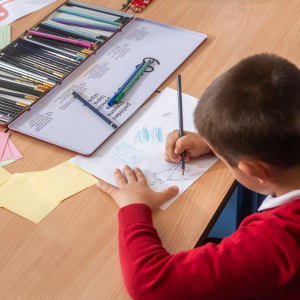
Simple, clear Art Lessons for Elementary are the foundation for one’s future interest in creativity. The younger the child is, the more important it is that the assignment be clear, not require any advanced equipment, and produce a result by the end of one lesson. One method is to draw a picture using a dot-to-dot scheme or a grid, as this activity not only promotes the development of fine motor skills but also makes the kid feel confident with a pencil in hand. Another surefire approach is to create a still life picture from common objects such as fruit, a cup, or a book.
In addition, one needs to emphasize that simplicity does not mean a decrease in the possibilities for self-expression. Even a primitive technique like a monotype, in which paint is applied to a smooth surface and then printed on paper, can attract children’s attention owing to the surprise of an unpredictable outcome. In the same way, one can unexpectedly achieve a beautiful result by brushing paint through a stencil with a toothbrush, and this is a relatively simple process. The following are some lesson ideas for the elementary school classes:
- Finger painting: “Autumn Forest”.
- Colored paper collage: “Underwater World”.
- Watercolor leaf painting.
- Connect-the-dots: “Assemble a Constellation”.
- Creation of shapes from clay according to the model
This set of tasks does not require expensive equipment but allows the teacher to improvise; the same technique can be used for any season, holiday, or topic related to the class’s curricular work.
Online and Virtual Art Lessons for Elementary Students
With the introduction of distance learning, artistic courses have been offered in a virtual format, providing additional opportunities for schools and parents seeking remote learning. Video lessons help children understand how pictures are painted, follow the instructor’s brush techniques, and won’t depend on the schedule of an after-school course. Small schools just lack a teacher specializing in art, which is why pre-recorded video lessons are one of the few ways to teach art to kids.
Distance learning is very convenient, as you can replay the lesson if needed: if a child cannot keep up with the pace of a live lesson, they can always pause the video. Elementary school teachers with no special background in art will benefit from such courses, as they don’t need to develop an entire curriculum on their own; they just need to watch the video and follow the same steps the children do. But there are features to take into account while choosing a virtual format:
- It is necessary to prepare everything in advance so that the child is not distracted while following the lesson.
- The computer screen cannot replace face-to-face communication; it would be good to show the finished work to the teacher or parents directly once in a while.
- The video lesson must be age-appropriate; it is difficult for young schoolchildren to pay attention for more than 20-25 minutes.
- It is better to select programs with structured lesson plans rather than chaotic video content lacking a clear logical structure.
The role of parents in remote learning also deserves special mention: even when a professional teacher conducts the lesson, it is beneficial for an adult to get involved—at least occasionally—by helping with materials, asking a few clarifying questions after the session, or simply praising the finished work. Such involvement does not replace the instruction itself, but it significantly boosts the child’s motivation, especially when they are studying at home rather than in the familiar school environment among classmates.
Furthermore, the online format complements in-person classes well: many schools use video lessons as a foundation and then reinforce the material face-to-face by discussing students’ work and suggesting refinements away from the screen.
Educational programs like Meet the Masters focus on children’s creativity are built to meet these needs perfectly. For instance, Meet the Masters provides “a comprehensive box”—including an activity script, detailed worksheets, and quality materials such as oil pastels, foil, and clay—that lets students create high-quality projects. It meets the requirements of VAPA standards, has a lot of history, and presents the works of masters from eleven countries. Additionally, a teacher does not need any special qualifications or extensive lesson preparation for this program—he simply needs to use the materials and see the sparkle in students’ eyes.
Elements of Art Lessons for Elementary
Before the child is allowed to play freely with their own composition and style, it may be worthwhile for them to learn about the fundamental vocabulary of the visual language.
These are not theoretical ideas but very practical ones that can be used immediately to help children understand what they are doing when they draw.
The first one is the line, which can either be straight or curved, thick or thin, each characteristic capable of expressing the mood of the drawing. Second, there is the shape – a closed contour on a two-dimensional plane in the form of a circle, square, or some other shape.
Next is the color, that involves hue, intensity, lightness, and color mixing principles. Another one is texture – the quality of something as perceived through our sense of touch, or the creation of this illusion in a two-dimensional picture. And lastly, there is space – depth and volume on a two-dimensional sheet of paper, something that even kids learn to do using the rules of perspective – making far-away things small.
To reinforce the knowledge about these principles, it would be beneficial to offer the children some of the following exercises:
- Drawing an object by means of lines with different degrees of thickness;
- Creating a composition out of simple geometric forms without paying attention to small details;
- Combining paints to get a new color and write down the ratio;
- Showing the texture of wood or stone by using hatching or shading;
- Painting a street in such a way that far buildings look smaller than closer ones.
It will become much easier for a child to analyze other paintings and deliberately build their own composition in the future when he/she is familiar with these basic elements through practical work.
Fun Art Lessons for Elementary Students
In addition to being educationally valuable, the activity should be fun so that the children do not get bored and remember it. It is particularly useful in this context to incorporate game elements into the activity: competition, teamwork, and the use of unusual materials can make a regular class interesting enough for the children to remember it long after it was finished, especially during their painting activity.
The best way to do so is probably to have all the children create the same mural. Each kid is responsible for a particular part of the whole picture, which then becomes one big picture, either a map of a make-believe city or a huge tree, where the leaves were drawn by each kid separately.
Children also react positively to projects that use non-traditional materials, for instance, drawing with chalk on asphalt, building sculptures from recycled objects, or painting rocks with acrylic paint. Such projects challenge the perception of creativity as something possible only with paper and pencil and show that there are virtually no limits on what materials children can use to make their creative projects.
Here is a list of project ideas which usually make children happy:
- “Our Magical City” collaborative mural;
- Painting rocks to create tiny animals;
- Creating masks for celebrations using paper plates;
- Painting with glow-in-the-dark paints under low light;
- “Robot from the Future” sculpture out of recycled materials.
And indeed, the combination of playfulness, unexpectedness, and shared achievements makes such events unforgettable, as the child can combine the process of creation with joyful feelings, which will make him or her willing to repeat it again and again.
In conclusion, good art activities for elementary school children require a balance of simplicity and complexity, personal contact and computer technology, theoretical knowledge and playful activities. And when the adult manages to find this combination, visual arts become not just one more lesson on the curriculum but an integral element of the child’s perception of the world.
