
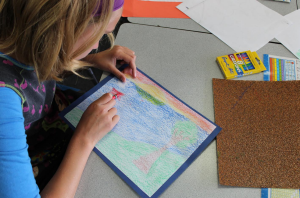
Imagine painting an entire canvas, dot by dot.
That’s exactly what Georges Seurat did.
And when you step back far enough, those thousands of tiny dots of pure color blend together into a complete, luminous scene.
Seurat wasn’t just making interesting paintings. He was applying color science to art, working out how the human eye perceives color when small dots are placed next to each other rather than blended on the palette.
It’s one of the most fascinating techniques in art history. And for students, it’s genuinely captivating.
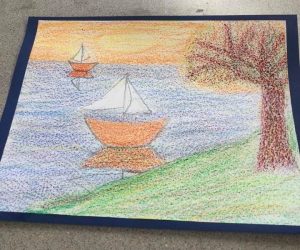
Pointillism teaches a handful of things at once, quietly, without making a big deal about it being educational:
- Color theory. Students work with primary and secondary colors and discover how they interact when placed side by side. It’s something most kids have learned in theory but rarely get to experience this directly.
- Patience and persistence. There’s no rushing pointillism. Each dot is a small commitment. Students who work through a pointillist piece develop a kind of focus and follow-through that carries over into other things.
- Fine motor skills. All those deliberate dots, precise, controlled, repeated, strengthen hand coordination and pencil control in a way that feels nothing like a handwriting exercise.
- Big-picture thinking. Part of what makes pointillism so satisfying is the reveal. Step back from the paper and suddenly the dots become something. That experience of zooming out to see the whole is something kids remember.
Seurat is one of our 35 masters, and his lessons never fail to produce beautiful results.
See what students create with Seurat: meetthemasters.com/artists
Meet the Masters
Inspire – Educate – Create
Dig Deeper:
