
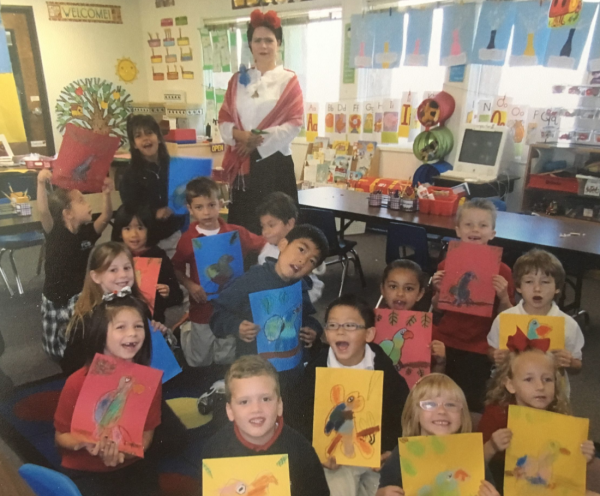
Art history is one of those subjects that sounds impressive on a schedule but can feel intimidating to teach — especially if a school doesn’t have a dedicated art teacher. The good news? Research consistently shows that structured, artist-based art history lessons are some of the most effective and cross-curricular learning experiences you can give elementary students. And with the right program, your own classroom teachers or parent volunteers can deliver them confidently.
Here’s what the research says, what approaches work best, and how programs like Meet the Masters bring it all together with 35 master artists that students genuinely remember.
What the Research Says About Art History for Elementary Students
The case for art history education has never been stronger. A landmark study published by the Brookings Institution found that arts education significantly improves school engagement — by as much as 8 percent of a standard deviation — and increases students’ college aspirations and their ability to empathize with others. Students in schools with more arts exposure were also more likely to report that their schoolwork was enjoyable and made them think in new ways.
The Education Next study, “The Fine Art of School Engagement,” confirmed that expanding arts education improves writing test scores by 13 percent of a standard deviation, and — critically — does not come at the expense of other academic performance. Arts learning helps, not hurts.
The Kennedy Center for Education has found that schools intentionally using arts integration see student achievement rise by 10% or more across the board. Their research defines arts integration as teaching and assessing content standards equitably in and through the arts — which is exactly what structured art history lessons do.
A review published in ERIC (How the Arts Benefit Student Achievement) found discipline-specific connections: drawing and visual arts support writing skills, while studying visual art builds critical observation skills that transfer to science and social studies. Johns Hopkins University School of Education researchers add that instruction becomes measurably more effective when educators make creative activities central — not supplemental — to academic development.
The bottom line: art history isn’t a “nice to have.” It’s a proven academic lever.
What Makes an Art History Lesson Actually Work for Elementary Students?
Research and classroom experience point to a few non-negotiables:
Artist-based learning over abstract history. Kids remember people, not periods. Learning that Vincent Van Gogh painted with thick, swirling brushstrokes while struggling emotionally is far more memorable than memorizing “Post-Impressionism, 1886–1905.” When the story of the artist comes first, the history sticks.
Visual, hands-on, and sequential. Art history lessons that end with students making something — a Seurat-style pointillist painting on sandpaper, a Mondrian-inspired grid, a Van Gogh sky — encode the learning far more deeply than passive observation. The Art Sprouts research review confirms that children need visual, multi-sensory engagement to absorb and retain art history concepts.
Standards-aligned and cross-curricular. The most defensible art history programs connect directly to state visual arts standards and to other core subjects. This is what keeps principals and curriculum directors enthusiastic — art history isn’t taking time away from academics; it’s reinforcing them.
Structured enough for non-specialists to deliver. A lesson that only a trained art teacher can run will never reach every student. The most effective programs are designed so that classroom teachers, enrichment coordinators, and parent volunteers can step in with confidence.
Meet the Masters was built around all four of these principles.
The 35 Artists: A Cross-Curricular Goldmine
Meet the Masters’ curriculum spans 35 master artists across five tracks, covering Renaissance masters through 20th-century modernists — with intentional representation of American, European, Japanese, Mexican, Native American, and African American artists. Every lesson is standards-based and packed with cross-subject connections.
Here’s how several of these artists map to core school subjects:
Math & Geometry
Piet Mondrian’s grid-based compositions are a natural classroom entry point for geometry, symmetry, and fractions. Students studying his work can count rectangles, identify perpendicular lines, and create their own balanced compositions — making abstract math visual and tangible.
M.C. Escher is beloved by math teachers for good reason. His tessellations, impossible staircases, and perspective tricks make concepts like spatial reasoning, transformations, and geometric patterns come alive. An Escher lesson is one of the strongest math-art bridges in any K-8 curriculum.
Georges Seurat’s Pointillism introduces the science of color mixing and light — and his work connects to multiplication when students count the “dots” that make up an image, making it a math, science, and art lesson simultaneously.
Science & Nature
Leonardo da Vinci is the ultimate cross-disciplinary figure. His anatomical drawings, engineering sketches, and scientific observations make him a natural anchor for science units on human biology, simple machines, and observation skills. Students learn that science and art aren’t separate — they’re both about looking closely and asking questions.
Georgia O’Keeffe’s oversized flower paintings give teachers a perfect bridge into botany and plant science. Magnified natural forms encourage scientific observation while teaching proportion and composition.
Claude Monet’s Impressionist landscapes open conversations about light, seasons, and the science of color perception — while connecting to weather, geography, and the natural world.
History & Social Studies
Jacob Lawrence painted the story of the Great Migration — the movement of African Americans from the rural South to the urban North — in his landmark Migration Series. His bold, flat shapes and powerful storytelling make history visual and emotionally immediate for young students. A Lawrence lesson pairs naturally with civil rights history units.
Frida Kahlo’s work is inseparable from Mexican history, cultural identity, and the politics of her era. She’s a powerful figure for social studies units on Mexico, Latin American culture, and the role of personal experience in art and expression.
Faith Ringgold’s story quilts — including Tar Beach, which many students already know from the picture book — connect directly to African American history, the Harlem Renaissance, and the tradition of storytelling through textile arts. Her work links art class to both social studies and language arts in a way few other artists can.
Katsushika Hokusai provides a window into Japanese history, culture, and geography. His iconic The Great Wave is a starting point for discussions of Japanese society, the relationship between humans and nature, and cross-cultural artistic traditions.
Maria Martinez, the Pueblo potter, brings Native American history and culture into the art room with authenticity. Her story — how she worked with her husband Julian to revive and share traditional black-on-black pottery — is a rich social studies lesson about preservation, identity, and artisanship.
Frederic Remington and Winslow Homer both illuminate American history — Remington through the mythology and reality of the American West, Homer through Civil War-era scenes and American landscapes. Both pair naturally with U.S. history units.
Grant Wood’s American Gothic and his Regionalist paintings of the Midwest open discussions about American identity, rural life, and the role of art in capturing a cultural moment.
Reading & Language Arts
Norman Rockwell told stories. Every painting he made has characters, a setting, a conflict, and a mood — the building blocks of narrative writing. Studying a Rockwell illustration and then writing the story behind it is one of the most natural language arts integrations in art history.
Marc Chagall’s dreamlike, floating figures and vivid storytelling make his work a natural companion for units on folklore, fairy tales, and imaginative writing. Students can learn about his Eastern European Jewish heritage and then write their own illustrated stories in his style.
Henri Rousseau’s jungle scenes — painted by a self-taught artist who had never visited a jungle — spark rich conversations about imagination, observation, and how writers and artists create worlds they’ve never seen.
Diversity, Equity & Cultural Understanding
A well-designed art history curriculum reflects the full range of human creativity. Meet the Masters deliberately includes artists from diverse cultural backgrounds, genders, and life experiences — Rosa Bonheur (French female Realist who challenged gender norms), Frida Kahlo (Mexican, disabled, politically active), Jacob Lawrence (African American), Maria Martinez (Native American), Faith Ringgold (African American female), Katsushika Hokusai (Japanese) — so that every student can see themselves in the story of art history. View all 35 iconic artists here.
This matters academically and socially. Research from the National Endowment for the Arts consistently finds that multicultural arts programming improves student engagement and strengthens school climate — particularly for students from underrepresented communities.
Standards-Based: What That Actually Means
“Standards-based” is one of those phrases that can mean a lot or a little depending on the program. For an art history curriculum to genuinely qualify, it should align with:
- National Core Arts Standards (Creating, Presenting, Responding, Connecting)
- State visual arts standards (which vary but typically include art history and cultural context)
- Common Core connections to ELA (writing, reading informational text) and math (geometry, measurement)
- NGSS connections where applicable (observation, evidence-based reasoning)
- Social Studies/History frameworks for cultural and historical context
Meet the Masters lessons are written to align with all of these. Each artist lesson covers art history and cultural context (Responding/Connecting standards), technique instruction (Creating standards), and hands-on project execution (Presenting standards) — with explicit connections to grade-level math, science, social studies, or ELA built into the curriculum.
For districts navigating accountability pressures, this is the key: art history that’s cross-curricular isn’t competing with tested subjects. It’s reinforcing them.
How Easy Is It to Teach? Your Teachers and Parent Volunteers Can Do This
One of the most common objections districts raise about art history programs is staffing: We don’t have an art specialist. We can’t add another trained position. Who is actually going to teach this?
Meet the Masters was designed from the start to be taught by non-specialists — and it works. Here’s why:
Scripted presentations, narrated in the artist’s own voice. Each lesson includes a scripted presentation that walks the presenter — whether that’s a classroom teacher, a PE coach covering a free period, or a parent volunteer — through the artist’s life, style, and significance. No art degree required. No lesson planning from scratch.
Step-by-step project instructions with differentiation built in. Projects are designed for four grade-level bands (K-1, 2-3, 4-5, and 6-8), so a parent volunteer leading a session doesn’t have to figure out how to adjust for different abilities. The curriculum does it for them.
Art docent programs across the country already prove this model works. Districts like Northshore School District (WA) and Lake Washington School District have run robust parent volunteer art docent programs for years. Volunteers receive training, lesson plans, and materials — and then deliver monthly art lessons in classrooms without needing any prior art background. Research on volunteer teaching consistently shows that trained volunteers increase individualized instructional time and free up classroom teachers for deeper integration.
Teacher prep time is minimal. Because the materials, scripted lessons, and art supplies come together as a kit, classroom teachers aren’t spending their planning periods writing art history lessons from scratch. They’re facilitators and supporters — which means they actually use the lessons rather than shelving them.
Schools using Meet the Masters regularly report that teachers appreciate how the program integrates with what they’re already teaching — a Frida Kahlo lesson dropping into a Mexico unit, a Jacob Lawrence lesson timed to coincide with civil rights month, a Mondrian lesson bookending a geometry chapter.
Which Artists Work Best at Which Grade Levels?
While every artist in the Meet the Masters library can be adapted for grades K-8, some connect especially naturally to specific developmental stages:
Kindergarten & 1st Grade: Henri Matisse (bold color, simple shapes, cut-outs), Joan Miró (playful abstract shapes, imaginative figures), Alexander Calder (mobiles, balance, motion), Henri Rousseau (jungle animals, imaginative scenes)
2nd & 3rd Grade: Claude Monet (seasons, landscape, color), Paul Klee (pattern, color theory, music connections), Mary Cassatt (family scenes, Impressionism), Vincent Van Gogh (emotion, texture, night sky)
4th & 5th Grade: Leonardo da Vinci (science connections, anatomy, observation), Piet Mondrian (geometry, abstraction), Georges Seurat (science of color, Pointillism), Frida Kahlo (self-expression, culture, identity), Jacob Lawrence (civil rights history, social studies)
Middle School (6-8): Pablo Picasso (Cubism, multiple perspectives — including metaphorically), M.C. Escher (math, perspective, impossible constructions), Andy Warhol (Pop Art, media, consumerism, current events), Faith Ringgold (storytelling, quilting, African American history), Rembrandt Van Rijn (light, shadow, the art of portraiture)
The Bottom Line for Districts
The research is clear: art history education, done well, improves academic engagement, critical thinking, writing ability, cultural understanding, and school climate. It doesn’t compete with tested subjects — it strengthens them. And with a structured program like Meet the Masters, you don’t need a specialist in every classroom to make it happen.
Thirty-five artists. Five tracks. Every style, period, medium, and cultural heritage your students deserve to encounter. Taught by your teachers, your volunteers, or your art specialists — with scripted lessons, professional materials, and a program that’s been refined over 40 years of classroom use.
The best art history lesson for an elementary student is one that actually happens. Meet the Masters makes sure it does.
Learn more about Meet the Masters’ 35-artist curriculum, district pricing, and standards alignment at meetthemasters.com.
Related:
Best K–8 Art Curriculum Without an Art Specialist — Used by 1,000+ Districts
Art History Lessons That Integrate Art Across Multiple Subjects | Meet the Masters
How K–8 School Districts Scale Consistent Art History Lessons: 4 Real District Examples
Sources
- New Evidence of the Benefits of Arts Education — Brookings Institution
- The Fine Art of School Engagement — Education Next
- How the Arts Benefit Student Achievement — ERIC
- What is Arts Integration? — Kennedy Center for Education
- The Benefits of Arts Education for K-12 Students — U.S. News
- The WHEN Behind Teaching Art History to Kids — Art Sprouts
- Art Docent Program — Northshore School District
- LWSD Art Docent Program — Lake Washington School District
- Connections Between Education in the Arts and Student Achievement — Grantmakers in the Arts
