
The short answer: Whether art is taught by an art specialist, classroom teachers or parent volunteers, the schools that handle multiple grade levels well teach one master artist to every grade at once, with the same core technique leveled up by age. They group grades into a few skill levels instead of planning six separate curricula. They introduce each artist to whole grade bands in a single assembly, and they rely on scripted, timed, standards-aligned lessons and one consolidated supply order so prep doesn’t multiply with every grade.
That’s the approach Meet the Masters has refined since 1985 with more than 3 million K–8 students. This article walks through how it works in a real classroom, using our Van Gogh unit as the example. Many elementary schools don’t have an art teacher at all, so the approach has to work for whoever is teaching. This article is written for district curriculum coordinators and directors who need one art program that works in every school, with or without an art specialist.
The real problem is time, not talent
The hardest part of teaching art across grade levels isn’t creativity. It’s finding time in a packed school day. Whether it’s one art teacher covering K–5 or a dozen classroom teachers fitting art between reading and math, separate lessons for every grade mean planning, prepping and cleaning up six times over. The fix is a system where one plan serves every grade.
1. Teach one artist at four levels
Each of Meet the Masters’ 35 artist units is written at four levels: Kindergarten, Beginning (grades 1–2), Intermediate (grades 3–4) and Advanced (grades 5–8). Every grade studies the same artist in the same month. Vocabulary, technique and the project build as students get older.
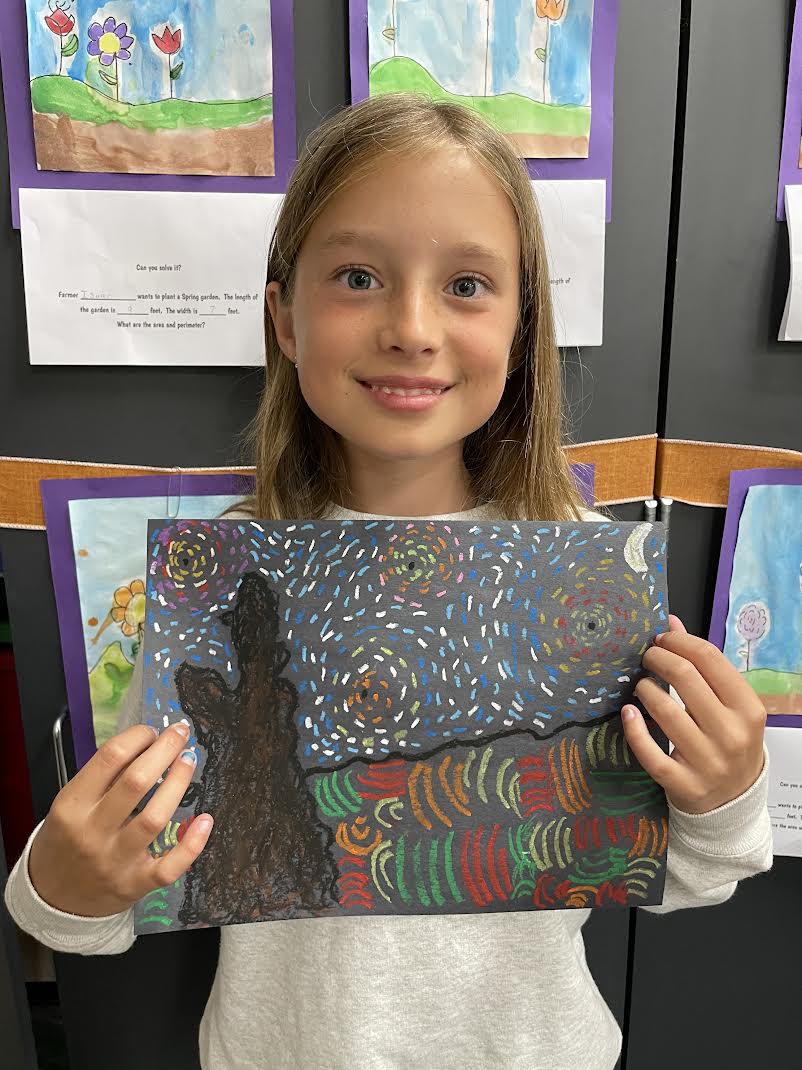 Here’s how our Van Gogh unit levels up. Every grade makes a Starry Night in oil pastel on black paper:
| Level | The project | New vocabulary |
|---|---|---|
| Kindergarten | One swirling spiral star over the night sky | Texture, color, spiral, brushstrokes |
| Beginning (1–2) | One to three broken-line spiral stars over a horizon line of hills | Broken line, horizon line |
| Intermediate (3–4) | Adds a cypress tree in the foreground, 3–5 stars, a crescent moon and “patchwork field” hills | Stroke, pressure, foreground |
| Advanced (5–8) | Adds a village built from geometric shapes, then discusses the emotion in Van Gogh’s strokes | Visual texture, movement |
Whoever teaches prepares one artist, one demonstration and one set of materials, then adjusts the complexity for each level. A kindergartner and a fifth grader walk away with the same artist and the same core skill, each at the right challenge.
2. Introduce each artist to a whole grade band at once
The artist introduction doesn’t need to be repeated classroom by classroom. Schools group students by level and hold one assembly, for example every 1st and 2nd grader in the building together. A K–5 school introduces each artist three or four times, not fifteen or more. Classroom teachers then use a short “Learning From” packet before the hands-on project.
3. Use scripted, timed, standards-aligned lessons
Every Meet the Masters lesson is fully scripted and timed to the minute, from setup to cleanup. Each one is aligned to arts standards and connected to other subjects like history, writing and geography. That means anyone can teach it well: an art specialist, a classroom teacher or a trained parent volunteer. An implementation guide and training videos cover planning, teaching and recruiting volunteers.
“The structure of the scripted lesson plans made it so easy to present to students,” says Lizz Davis, a teacher and volunteer at Castle Heights Elementary in Price, Utah.
4. Keep one supply order and a steady rhythm
Because every level uses the same core materials, schools place one supply order per artist. Meet the Masters sells the supplies with the curriculum, so there’s no shopping list to build for each grade.
Most schools teach one or two artists a month, covering two tracks of seven artists each over the school year. Each artist follows the same three-step system:
- Introducing: one assembly per grade band (kindergarten is introduced in the classroom).
- Learning From: a short leveled worksheet packet with the classroom teacher.
- Working With: the hands-on art project, about 45–60 minutes.
What most schools get wrong
Most multi-grade art programs fail because they treat art as a craft: a cute seasonal project that’s fun for an afternoon but gives students little meaning. Without art history and master artists behind it, there’s nothing to build on from one grade to the next.
The second mistake is leaning on screens. Hands-on art builds fine motor skills, judgment and spatial reasoning that a tablet can’t. And the payoff shows up in academics. In a randomized study of more than 10,000 Houston students, arts education raised standardized writing scores and reduced discipline problems (Bowen & Kisida, via Education Next).
What districts are seeing
- Fruitvale School District, Bakersfield, CA: Students had no formal art education before Prop 28 funding. Art teacher Cara Nicoletti says students “who were more hesitant about approaching art are diving in this year with much more confidence.”
- East Helena School District, MT: Art teacher Lisa Mortieau used the program to ensure “students built a strong foundation in art from K–5 and were well-prepared for middle school.”
- Del Lago Elementary, Orange County, CA: Art advocate Patty Roberts found “a curriculum that challenged the older elementary students, and was able to be done by the younger ones as well.”
Read more customer success stories and testimonials.
Why district curriculum leaders choose Meet the Masters
Meet the Masters was founded in 1985 by credentialed elementary school teachers. For more than 40 years it has been a leader in K–8 art history curriculum, reaching over 3 million students. For district coordinators and directors, that means one program that scales across every school: consistent, standards-aligned, fully supplied and ready to teach regardless of who’s in the room.
Talk to a real person
Planning art for your district? Our team is standing by Monday through Friday to answer questions, get you a quick quote and find the best fit for your schools. Contact us or request pricing. You’ll reach a real person, not a chatbot.
Frequently Asked Questions
How do elementary schools plan art lessons for multiple grade levels?
They teach the same artist to every grade and level the project by age. Grouping K–8 into four skill levels (K, 1–2, 3–4, 5–8) reduces planning from six or more curricula to one.
What if our school doesn’t have an art teacher?
Classroom teachers or parent volunteers can teach it with no art background. Meet the Masters lessons are scripted and timed, with an implementation guide and training videos included with purchase.
How do you handle combined-grade classrooms?
Pick the level that fits most students, then adapt within it. Lessons build in simple adjustments, such as fewer elements for younger students.
How many artists should an elementary school cover in a year?
Most Meet the Masters schools teach one or two artists a month, completing two tracks of seven artists over the year.
Is the curriculum standards-aligned?
Yes. Every lesson is aligned to arts standards and connects to other subjects like history and writing.
Does art education improve academic outcomes?
Research suggests it does. A randomized study of more than 10,000 Houston students found arts education improved writing scores and reduced discipline issues.
