
Picture two classrooms on the same afternoon. In one, kindergartners dab yellow paint onto a paper tree with cotton balls. In the other,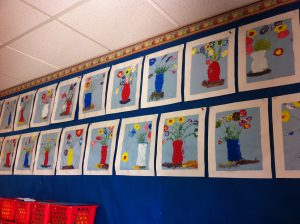 seventh graders cut a folded paper stencil for a vase of flowers.
Both groups are painting like Claude Monet. That’s the simplest answer to teaching art K-8: one artist, one core skill, and a project that grows with the student.
If you’re new to teaching art K-8, the range can feel huge. A five-year-old is still learning to control a crayon. A thirteen-year-old wants a real challenge and real choices.
Here’s how to approach teaching art K-8 without writing nine separate lessons.
Teaching art K-8 starts with one idea at four depths
Teachers call this differentiation. The IRIS Center at Vanderbilt University describes differentiated instruction as “an approach whereby teachers adjust their curriculum and instruction” so that every student in the class learns more.
In art, that doesn’t mean a different artist for every grade. It means the same idea, taught at different depths.
Meet the Masters builds every artist unit this way. Each unit comes in four levels: Kindergarten, Beginning (grades 1-2), Intermediate (grades 3-4) and Advanced (grades 5-8). Each level follows the same three-step method:
- Introducing: a scripted presentation about the artist (20-45 minutes).
- Learning From: a short practice packet at the student’s level (15-30 minutes).
- Working With: the hands-on art project (50-60 minutes).
Here’s how the Claude Monet unit carries one lesson, “Monet’s Colors,” from kindergarten to eighth grade.
How one Monet lesson changes from kindergarten to 8th grade
Kindergarten: a story, a color wheel, a tree
Kindergartners meet Monet in their own classroom, not at an assembly. The scripted introduction takes about 11 minutes. It opens with a box of crayons missing two colors: black and brown. Monet, the script explains, didn’t use them.
Students pick up “pretend paintbrushes” and dab the air the way Monet painted. Then they become “art detectives,” pointing to the short dabs and dots in a large Monet print.
The project uses the Beginning lesson with one change. The kindergarten instructions say: “Paint the color wheel one day and do the tree exercise on another day.” Two short sessions suit short attention spans.
Beginning (grades 1-2): mixing colors on the paper
First and second graders color an Impressionist color wheel with red, yellow and blue crayons. They layer two primary colors to make orange, purple and green. In the center, they layer all three to make what the lesson calls a “living brown.”
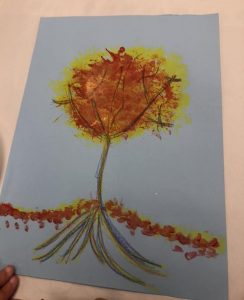
Then they draw a tree trunk on light blue paper and dab on leaves with cotton balls. Each student picks a season: red and yellow for fall, or yellow and blue for spring. Their practice packet asks them to fill frames with colors that feel “Hot,” “Soft,” “Bright” and “Strong.”
Intermediate (grades 3-4): a landscape with light and shadow
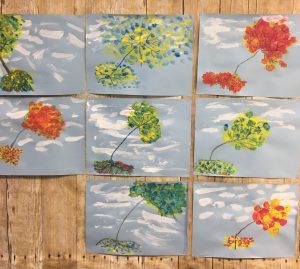
Third and fourth graders turn the paper sideways. Their tree leans “as if blowing in the wind,” like the trees in Monet’s landscapes. They sweep a thin layer of white across the sky.
They can add a third color for shadows and highlights, which means thinking about where the light comes from. The vocabulary grows, too, with words like complementary colors and landscape.
Their introduction asks them to imagine being remembered 100 years from now for changing art history.
Advanced (grades 5-8): an Impressionist still life
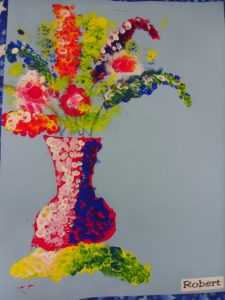
Older students paint a still life instead of a tree. They fold a 4″ x 6″ sheet of construction paper, cut half a vase shape and use the border as a
stencil. They draw 5 to 7 stems, then dab on flowers, mixing secondary colors right on the paper.
Last, they anchor the vase with a shadow and a highlight, working from a light source they choose.
Their introduction turns the class into the jury of the Paris Salon. Students give each painting a thumbs up or down, then vote on which Monet belongs in the exhibit.
What stays the same at every grade level
The project changes. The foundation doesn’t. That’s what makes teaching art K-8 manageable for one teacher or one school.
- The same artist. Every grade studies Monet, so the whole school shares one conversation.
- The same core skill. Every level starts with the color wheel and the “living brown.”
- Nearly the same supplies. Each student gets one 9″ x 12″ sheet of light blue construction paper, a sheet of newsprint and a paper plate palette of red, yellow and blue tempera. Grades 3-8 add white paint. Advanced students add one 4″ x 6″ piece of scrap construction paper.
- The same routine. Set-up, orientation, demonstration, then an “Impressionist Art Exhibit” where the classroom becomes the gallery.
5 tips for teaching art K-8 as a new teacher
These ideas come straight from how the lessons are built. They work with any artist.
- Keep the artist, change the depth. Choose one master and one skill, then add steps for older grades.

- Match the talk to the age. Young students need a story and movement. Older students are ready for debate, voting and bigger vocabulary words.
- Split long projects for the youngest. In kindergarten, two short sessions often work better than one long one.
- Add choice as students grow. Beginning students choose a season. Intermediate students decide where the light falls. Advanced students design their own vase and bouquet.
- Demonstrate, then let them repeat. The lesson plans put it simply: “Explain and demonstrate each step. Have the students repeat it immediately with their materials.”

Remember that students in the same grade start from different places, too. As an NAEYC article on children’s art puts it, “A scribble is never just a scribble.”
What educators say
Educators point to the same strength for teaching art K-8: clear steps that let every student succeed.
“The step by step instruction creates a comfortable environment for all children to excel and explore their creative side.”
— Patty Roberts, Art Advocate, Del Lago Elementary, Orange County, CA
“The structure of the scripted lesson plans made it so easy to present to students.”
— Lizz Davis, Elementary School Teacher & Volunteer, Castle Heights Elementary, Price, UT
Read more testimonials from teachers and schools.
For schools and districts
For curriculum directors, VAPA leads and principals, teaching art K-8 is a staffing question as much as a teaching one. Who will lead art in every classroom, and will it build from one grade to the next?
- One adoption, K-8. Every one of the 35 artist units in this elementary art curriculum is written at four levels.
- Built for non-specialists. Scripted lessons let classroom teachers, art teachers and parent volunteers lead.
- Optional training videos. MTM staff demonstrate each project step by step for every grade level.
- A clear sequence. The National Core Arts Standards describe “a unified quality arts education for students in Pre-K through high school.” Leveled lessons give each grade a place in that sequence.
Compton Unified School District teaches Meet the Masters in 21 elementary schools and 6 middle schools. Alicia Weyeneth, the district’s Curriculum Specialist, put it this way:
“It fits perfectly into our multi-tiered systems of support model.”
— Alicia Weyeneth, Curriculum Specialist, Compton Unified School District, Los Angeles, CA (read the Compton case study)
Comparing programs? Our guide on how to choose a K-8 art curriculum walks through the questions to ask.
FAQ: teaching art K-8
What is the best way to approach teaching art K-8?
The simplest approach to teaching art K-8 is to teach one artist and one core skill to every grade, then change the depth of the project. In Meet the Masters, kindergartners paint a Monet tree over two short sessions, while grades 5-8 paint a full Impressionist still life.
How do you differentiate an art lesson for different grade levels?
Keep the artist and the skill the same, and adjust the steps, vocabulary and choices. Younger students follow one step at a time. Older students plan light, shadow and composition.
Do I need an art background to teach K-8 art?
No. Meet the Masters lessons are scripted, with suggested times for every step, so classroom teachers, art teachers and parent volunteers can lead them.
Bring Meet The Masters to your school
Teaching art K-8 doesn’t take nine lesson plans. It takes one good one, written for every level.
Get pricing for your school or district, and give your kindergartners and eighth graders the same master this year, each at the right level.
