
Short answer: A complete elementary art curriculum includes six things: the history, culture and life story of each artist; active learning that makes that history stick; real techniques and art vocabulary that build from grade to grade; hands-on projects with varied materials; alignment to state and national arts standards; and enough teacher support that anyone can teach it well.
Most programs cover the projects and skip the rest. That’s the gap we see most often after 40 years and more than 3 million students at Meet the Masters.
Our view is simple. Art history and culture are the foundation, not an extra. Without them, a child can copy a painting but can’t understand why the artist made it, or what was happening in the world at the time. Below is what each component looks like in a real classroom, using our Leonardo da Vinci unit as the example.
The 6 essential parts of an elementary art curriculum
- Artist history, culture and life story
- Active learning that makes the history click
- Real techniques and vocabulary that build each year
- Hands-on projects with materials that teach
- Standards alignment and cross-curricular connections
- Teacher support so anyone can teach it
1. The artist’s history, culture and life story
The first thing a curriculum should teach is who the artist was and what world they lived in. That context explains the choices on the canvas.
In our Leonardo da Vinci unit, students learn that:
- His name is a place. “Da Vinci” means “from Vinci,” the small Italian town where he was born.
- He lived in a time of new ideas. The Renaissance (1300–1600) was “a new age of thinking and learning,” when many people still thought the world was flat.
- Portraits were the only photographs. There were no cameras, so families hired artists to record how someone looked. That’s why the Mona Lisa exists at all.
- Culture shaped the details. Men wore hats for fashion and warmth, and on Sundays the law required it. That’s why our students draw Renaissance hats on their portraits.
- He was more than a painter. Kids discover his inventions, his backwards mirror writing, his anatomy studies and the 5,000 pages of notebooks he left behind.
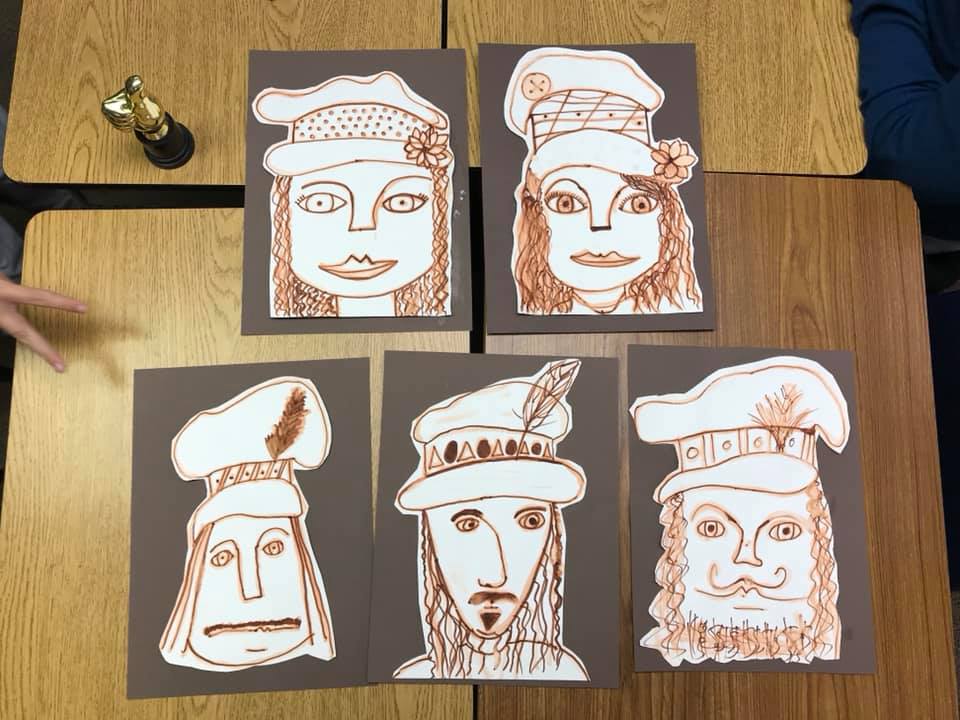
When kids know this, the art stops being a picture on a slide. It becomes a decision a real person made, for real reasons.
2. Active learning that makes history click
History sticks when kids take part in it. In our experience, it clicks in two moments: when students answer questions throughout the assembly, and when they act out scenes from the artist’s life and times.
Questions all the way through
Our assembly scripts are built as a running conversation. The presenter asks, the kids answer. “Did people 500 years ago have cameras?” Kids guess Lisa del Giocondo’s age from clues. Older students build a list of Leonardo’s talents together as the story unfolds, then use it in a review game at the end.
Acting it out
In the Mona Lisa story, kids strike a silent pose every time they hear a name:
- “Lisa”: sit up tall with “just an ever so little smile.”
- “Francesco”: look like the man of the house, in charge of everything.
- “Leonardo”: look extremely smart, pencil and paper in hand.
Older students copy the faces in Leonardo’s Grotesque Heads and imitate the shocked gestures of the apostles in The Last Supper. A child who has acted out that surprise understands the painting from the inside.
This is what a slideshow or worksheet can’t do. Kids aren’t memorizing dates. They’re living a moment from 500 years ago for a few minutes.
3. Real techniques and vocabulary that build each year
A strong curriculum teaches the artist’s actual methods, plus the words to talk about art. It also builds year over year, so a fifth grader isn’t repeating a kindergarten project.
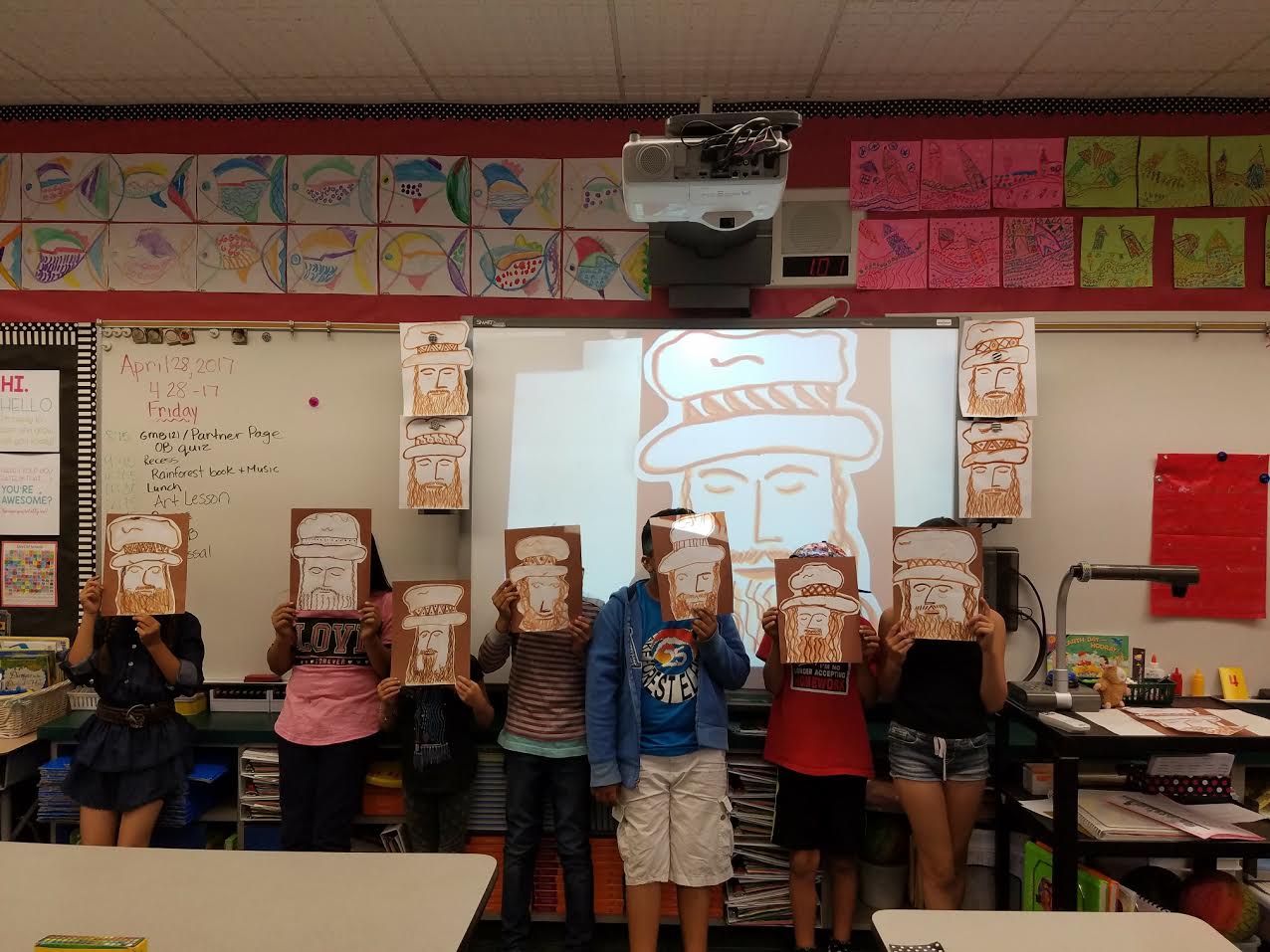
At Meet the Masters, each of our 35 artists is taught at four levels. The artist stays the same; the vocabulary, techniques and projects grow. Here’s how the da Vinci unit builds:
| Level | Grades | New vocabulary | What students draw |
|---|---|---|---|
| Kindergarten | K | Self-portrait, line, detail, realistic | A Renaissance hat decorated with line patterns |
| Beginning | 1–2 | Portrait, drawing, painting | A realistic Renaissance portrait, measured with fingers |
| Intermediate | 3–4 | Sketch, shading, Renaissance | The same portrait, adding open eyes and detail |
| Advanced | 5–8 | Fresco | Shading and shadow under the hat, eyes and nose |
Before the project, students practice in learning packets the way Leonardo did. He kept a “sketch dictionary” of noses, eyes and mouths. Our students divide an oval face to find where the features go, then sketch them before drawing their final portrait.
4. Hands-on projects with materials that teach
The project is where everything comes together, and the materials matter more than most people think. Each new material asks a child’s hands and brain to work in a new way.
Our units go well beyond crayons and markers. Students work with foil, clay, tissue paper, paint, oil and chalk pastels, and collage. Some lessons even use dress-up, so kids can step into the artist’s world before they create. Longtime volunteer Joy Stone still remembers favorites like the Maria Martinez clay project and the Alexander Calder mobile.
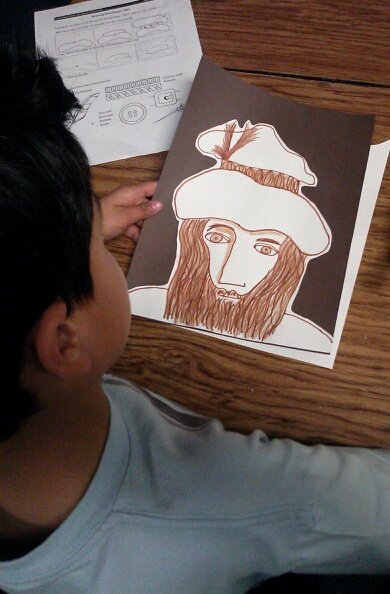
The key is that every material connects back to the lesson. In the da Vinci unit, kids use a brown marker and a wet Q-tip to pull the lines into soft shading, echoing the red chalk of Leonardo’s self-portrait. The material reinforces what they just learned about the artist.
Our strong opinion: hands-on learning beats any amount of screen time. Kids spend enough of their day looking at a screen. Shaping clay, crinkling foil and layering tissue builds skills and confidence that no app can.

5. Standards alignment and cross-curricular connections
For districts, standards alignment isn’t optional. A curriculum should map clearly to your state’s visual arts standards, such as California’s VAPA standards, and to the National Core Arts Standards. As one Oceanside Unified educator put it, “MTM meets our requirements because it’s standards-aligned and extremely engaging for students.”
The best art lessons also reinforce other subjects naturally. One da Vinci unit touches:
- History: the Renaissance, and how The Last Supper survived WWII bombing
- Science: anatomy, botany, observation, and inventions like his flying machines
- Math: measuring facial proportions with fingers
- Language: Italian words like da, Mona and arrivederci
- Music: the lyre Leonardo played, and Renaissance music during the assembly
Assistant Principal Karen Romito of Lakewood Elementary in Sunnyvale said it best: “I’ve never seen a program that provides this integration, and goes beyond the silly, little holiday crafts.”
6. Support so anyone can teach it
Many elementary schools don’t have an art teacher. Art is often taught by classroom teachers or parent volunteers, so the curriculum has to do the heavy lifting.
That means:
- Scripted lessons. Every word of the presentation is written out, with expected student answers and pronunciation guides (“duh VIN-chee”).
- Timed segments. Each step has a suggested time to fit a 50–60 minute class.
- Supplies in the box. Teachers shouldn’t have to hunt down materials for every lesson.
- Training and prep guides. Volunteer instructions, an implementation guide and training videos.
Teachers notice the difference. “The structure of the scripted lesson plans made it so easy to present to students,” said Lizz Davis, a teacher and volunteer at Castle Heights Elementary in Utah. Parent volunteer Beth Allin of Fairlawn Elementary in Florida agreed: “Volunteering was simple with all the instructions and training videos.”
Case study: Fruitvale School District goes from no art to art every week
Fruitvale School District in Bakersfield, California, serves about 3,000 students across five elementary schools. “Our students had never had formalized art education before Prop 28 funding allowed us to hire art teachers,” said art teachers Cara Nicoletti and Kristina Franklin.
They needed a curriculum that met California’s VAPA standards, included art history, taught real techniques, and worked across every grade without writing lessons from scratch. They chose Meet the Masters for all five schools, K–5, with supplies included.
What they’ve seen since:
- Students look forward to art time every week.
- A student pointed out the texture of a shirt at a store and connected it to art class.
- Kids created Frida Kahlo–inspired still lifes at home.
- “Many students last year who were more hesitant about approaching art are diving in this year,” said Nicoletti.
One moment says the most about history’s role. After watching a lesson, a teacher’s aide told Franklin that “the inclusion of the art history would have made all the difference to her as a child.”
That lasting effect shows up in our testimonials again and again. “The children are able to recall facts about the artist long after the project,” said Kayla Jernigan of Friends Christian School. Enrichment teacher Ashley Haight in Oceanside put it this way: “Students are really enjoying learning about each artist and how their life story shaped them to become a master.”
Red flags when you’re evaluating an art curriculum
If you’re comparing programs for your district, watch for these warning signs:
- Crafts with no context. A “project of the week” that never connects to an artist’s history, culture or technique is a craft, not a curriculum.
- No clear standards alignment. If the publisher can’t show how lessons map to your state standards, keep looking.
- The same project at every grade. Look for vocabulary and skills that build from kindergarten up.
- One or two materials all year. Crayons and markers alone won’t stretch kids. Look for clay, foil, tissue, paint, pastels and more.
- Screens doing the teaching. Videos can support a lesson, but kids should spend most of art time making things with their hands.
- Lessons that assume an art degree. If a classroom teacher or parent volunteer couldn’t pick it up and teach it tomorrow, it won’t get taught consistently.
Frequently asked questions
What should an elementary art curriculum include?
Artist history and culture, active learning, real techniques and vocabulary that build by grade, hands-on projects with varied materials, standards alignment, and teacher support such as scripts, timing and supplies.
Why teach art history to young kids?
History and culture explain why an artist made what they made. Kids who know the story remember the artist, understand the art, and connect more deeply to their own work.
Can a classroom teacher or parent volunteer teach art without an art background?
Yes, with the right curriculum. Scripted, timed lessons with included supplies and training videos let non-specialists teach confidently.
How is an art curriculum different from craft projects?
A craft is a one-off activity. A curriculum connects every project to an artist, a time and place, and a technique, and builds skills from year to year.
How many artists should students study?
Variety matters. Meet the Masters offers 35 artists from around the world, each taught at four grade levels.
See what a complete curriculum looks like
Meet the Masters has helped teachers, parents and districts teach art history and real technique to more than 3 million students since 1985. Explore our 35 artist units and see how easy it is to bring a complete, standards-aligned art program to your school.
