
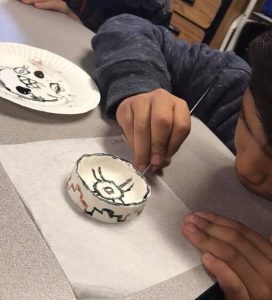
Every art project is a series of problems.
What color should this shadow be? How do I make the background recede? The paper tore, now what? My proportions are off, how do I fix it?
Students making art are constantly diagnosing, adjusting, and deciding.
And because the stakes feel low, it’s art rather than a test, they’re often more willing to take risks, try things, and think laterally than they are in other subjects.
That’s exactly the kind of thinking that educators, researchers, and employers have been pointing to for decades as the skill that matters most. Creative, flexible, problem-solving thinking.
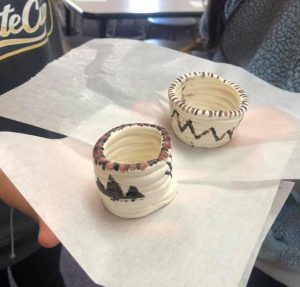
Meet the Masters builds this in several concrete ways:
- Decision-making under uncertainty. Abstract and impressionist techniques ask students to make choices without a single correct answer. That’s a real cognitive workout.
- Sequential thinking. Our 3-step process, assembly, technique packet, art project, teaches students to work through a structured process from start to finish, building procedural thinking they’ll use in math, science, and beyond.
- Spatial reasoning. Composition, proportion, perspective. All of these require students to think spatially about how objects relate to each other. Studies consistently link art education to stronger spatial reasoning skills.
- Adaptive thinking. Things go wrong in art. A color comes out different than expected. A line goes somewhere unplanned. Students who learn to adapt and keep going are practicing resilience in a setting where the pressure is low.
Art students score an average of 100 points higher on the SAT. That number doesn’t come from nowhere.
See how Meet the Masters works in the classroom: meetthemasters.com/how-it-works
Warm regards,
Meet the Masters
Inspire – Educate – Create
Dig Deeper:
