
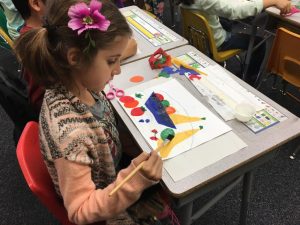
Tissue paper doesn’t seem like an art supply at first.
It’s thin, delicate, tears easily.
But those qualities are exactly what make it work for teaching layering and transparency.
We use tissue paper for three artists with completely different styles:
Cezanne’s still-life compositions, Lawrence’s bold geometric shapes, and Warhol’s pop art all translate beautifully to tissue paper collage.
The color variety is wider than most people expect.
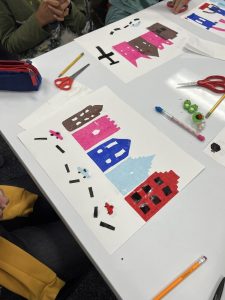
Students can choose from dozens of shades, layering them to create new colors where they overlap:
- Blue tissue over yellow creates green.
- Red over blue makes purple.
The transparency lets them see exactly how colors mix without needing paint.
Working with tissue paper requires a lighter touch than most supplies:
- Students learn to handle delicate materials carefully, which builds fine motor control and patience. The tearing and layering process is meditative in a way that drawing or painting isn’t.
- Teachers find it refreshing to work with a material that most students haven’t used in art class before. The process is different enough from their usual projects to feel special, but simple enough that setup takes minutes.
And tissue paper is budget-friendly.
A little goes a long way, and the results look impressive whether students are in kindergarten or middle school.
If you’re looking for a supply that teaches color theory through hands-on experience, tissue paper delivers. It’s quiet, manageable, and produces work that looks sophisticated on any wall.
See examples in our student gallery.
Warm regards,
Meet the Masters
Inspire – Educate – Create
Dig Deeper:
